
The United Nations Population Fund (UNFPA) has pledged its continued support

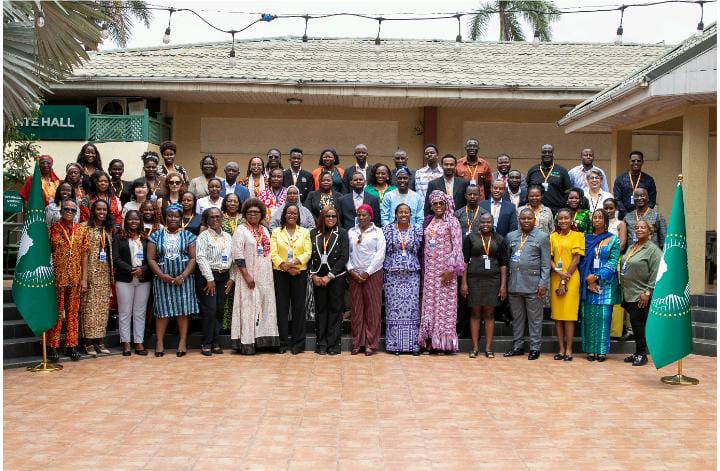
The United Nations Population Fund (UNFPA) has pledged its continued support for the operationalisation of the African Union Accountability Framework on Harmful Practices as Ghana joins other countries in a concerted effort to end violence and harmful practices against women and girls.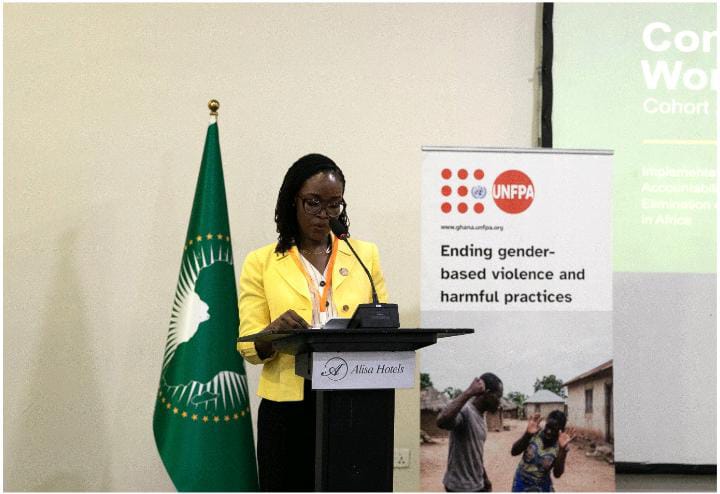
The commitment was made in Accra, where a four-day AU consultative workshop is underway to strengthen how countries implement and report on efforts to eliminate child, early and forced marriage and female genital mutilation (FGM). Organised by the African Union Commission and the Government of Ghana, in collaboration with UNFPA, UNICEF and other partners, the meeting is focused on turning continental commitments into measurable, accountable action across Africa.
Speaking at the opening, Deputy Country Representative of UNFPA Ghana, Dr. Emmily Naphambo, said the Framework is designed to turn existing continental and global commitments into measurable, accountable action at national and community levels.
Dr. Naphambo noted that African countries have demonstrated strong commitment to ending harmful practices through instruments such as the Maputo Protocol, the African Charter on the Rights and Welfare of the Child, Agenda 2063, CEDAW, the CRC and many others.
“Yet, despite these commitments, child, early and forced marriage and female genital mutilation continue to affect the rights, dignity, health, education, and future of millions of girls across our continent,” she said.
She stressed that the challenge is not a lack of commitments but rather translating them into effective implementation and measurable results.
“The challenge before us, therefore, is not a lack of commitments. African countries have shown strong leadership in ratifying regional and international human rights instruments.
The challenge is translating these commitments into effective implementation and measurable results at community level,” Dr. Naphambo said.
According to her, the AU Accountability Framework on Harmful Practices is not a new legal obligation but a practical mechanism to help Member States implement and report on obligations they have already undertaken.
“It can help us bring together information from different reporting processes, establish a common national evidence base, track progress through measurable indicators, and strengthen accountability for implementation,” she explained.
Ghana is part of Cohort Two of countries rolling out the Framework, following Cohort One, which comprises Djibouti, Ethiopia, Kenya, Senegal and Zambia. Dr. Naphambo said the experience of Cohort One has generated valuable lessons on indicators, data collection, coordination and overcoming reporting challenges.
“For Cohort Two, our task is now to learn and translate those lessons into practical actions and to integrate the Framework into existing national mechanisms and action plans,” she said.
She acknowledged that each country is unique, with its own context, legislation, institutional arrangements and patterns of harmful practices, but emphasised that the collective task is to strengthen implementation, monitoring, reporting, enforcement and survivor-centred protection.“We recognize that each country is unique, it has its own context, legislation, institutional arrangements, and patterns of harmful practices.
The foundation exists across our countries. Our collective task is to strengthen implementation, monitoring, reporting, enforcement, and survivor-centred protection,” Dr. Naphambo stated.
She expressed appreciation to the AUC Department of Health, Humanitarian Affairs and Social Development for its leadership in developing and advancing the Framework, and to UNICEF for its continued collaboration and commitment to ending harmful practices.
“UNFPA, together with UNICEF, the World Bank, the African Union, and our other partners, remains fully committed to supporting Member States in operationalizing this Framework,” she reaffirmed.
Over the next four days, participants are expected to focus on four practical priorities: strengthening multi-sectoral coordination so that relevant ministries and national institutions contribute to a shared accountability mechanism; making full use of available national data, including DHS and MICS, to strengthen evidence-based reporting and programming; ensuring meaningful engagement of civil society, national human rights institutions, community leaders and young people in monitoring progress and accountability; and leaving the workshop with clear, practical and country-specific operational roadmaps, supported by the necessary political commitment and resources.
“Let us remember, behind every statistic on child marriage or FGM is a girl whose rights, education, health, bodily autonomy, and future are affected. The AU Accountability Framework gives us an opportunity to ensure that our commitments translate into concrete action and that progress is measured, visible, and accountable”, Dr. Naphamb


